922
922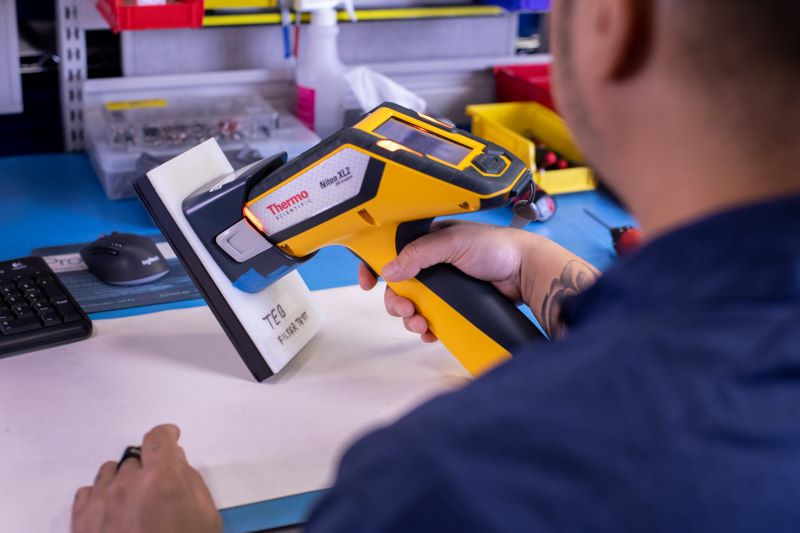
Portable Elemental Analysis: Niton™ XL2 Handheld XRF Analyzer
20 January 2025, Monday |
 922
922
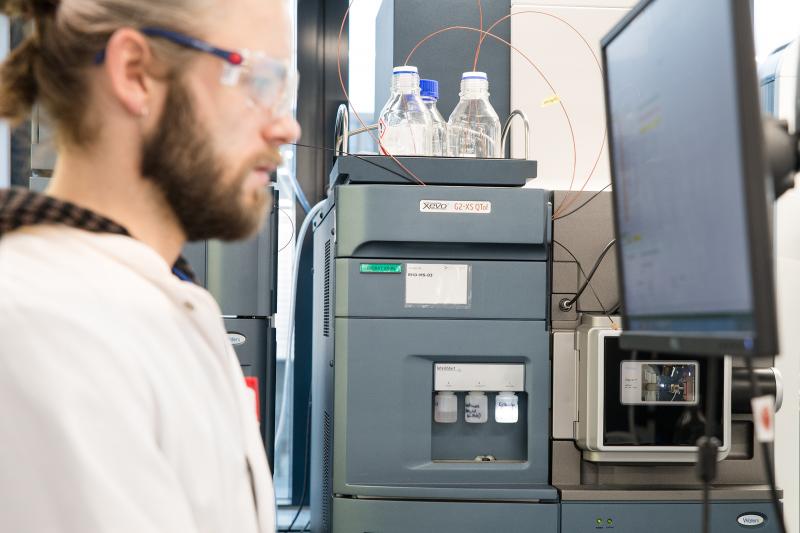
Liquid Chromatography (LC) - High Performance Liquid Chromatography (HPLC), Ion Chromatography (IC) and Liquid Chromatography with Mass Spectrometry (LC-MS)
Liquid chromatography is one of the most powerful tools in the analytical laboratory. It is very widely used for the separation and analysis of mixtures of compounds of all types. When combined with the sensitivity and selectivity of mass spectrometry its power is greatly enhanced.
How do High Performance Liquid Chromatography, Ion Chromatography and Liquid Chromatography with Mass Spectrometry work?
In Liquid chromatography a liquid (the mobile phase/eluent) under high pressure flows through an inert tube (column) packed with a fine powder which may be coated in a liquid (stationary phase). A sample is injected into the eluent before the column; as it moves through the column the time taken by each compound in the sample to reach the end of the column is governed by its interaction with the eluent and the stationary phase. This is dependent on the compound’s properties and can be used to separate mixtures of very similar compounds. Once separated, the compounds can be measured as they emerge from the column by a range of detectors, both non-selective and selective, including mass spectrometers.
Different packing materials support different separation mechanisms –normal-phase, reversed-phase, size exclusion, ion exchange, affinity, chiral, or hydrophilic interaction HPLC. Normal-phase LC uses a polar stationary phase and a less polar or non-polar eluent. In reverse-phase LC these polarities are reversed.
How does Ion Chromatography work?
Ion chromatography (IC) is a variant on HPLC where the stationary phase interaction is based on ion exchange. It is, therefore, applied to separate ions or charged species. Anions and cations are separated on separate columns. Unlike HPLC where much of the focus is on separating similar compounds, in IC the separations tend to be standard and the emphasis is on accuracy and sensitivity. Due to the different properties of ions, conductivity detectors are often used; to improve sensitivity the background conductivity of the eluent is removed before detection of the ions. To achieve much higher sensitivity the ions may be preconcentrated on a short ion exchange column and then eluted into the eluent stream for separation. This offers a very effective way of determining trace levels of many anions. IC is often used to complement the ICP-MS determination of metals in a sample.
What is Liquid Chromatography (LC) for?
Liquid chromatography includes by far the most common range of techniques used to determine one or multiple components in a mixture. By suitable choice of eluent and stationary phase all types of compounds in solution can be separated. HPLC is used for the high-pressure separation of mixtures of organic compounds. IC enables the determination of anions and cations and other charged species.. LC-MS has the advantage that it can provide selective detection of components, reducing the need to fully separate the components chromatographically. It can also provide extra structural and molecular weight information to assist identification.
Why would you use Liquid Chromatography (LC)?
High Performance Liquid Chromatoraphy (HPLC)
HPLC is the technique of choice when analysing materials for as wide a range of organic compounds as possible. Volatile compounds (VOCs and SVOCs) are usually best analysed by GC or GC-MS but HPLC is applicable to a much greater variety of mixtures, including non-volatile or thermally unstable molecules. Its advantages include versatility, sensitivity and applicability to very complex mixtures.
Ion Chromatography (IC)
IC is a variant on HPLC in which the stationary phase is ion-exchange resin. This enables the separation of ionic and charged components and it is commonly used to determine cations and especially anions in aqueous samples. It is easy to quantify and, with pre-concentration techniques, can achieve very high sensitivity.
Liquid Chromatography with Mass Spectrometry (LC-MS)
LC-MS offers high sensitivity and selectivity. It is the technique of choice for the analysis of complex mixtures of compounds both for the identification of unknowns and to obtain quantitative data on trace/minor components. The combination of LC and MS provides a great deal of information to help compound identification.
Types of Liquid Chromatography (LC)
The versatility of Liquid chromatography has led to a wide range of instrumentation for different applications. Virtually all LC is carried out under very high pressure required to pump the mobile phase through the fine beads in the packed bed. UHPLC uses finer beads and operates at even higher pressures.
There is a wide range of different detectors available. MS is the most powerful and flexible; many MS detectors are low resolution quadrupole units but high resolution mass spectrometers offer the scope for unambiguous identifications. Widely-used detectors include spectrophotometers for most high sensitivity applications and electrical conductivity for IC.
452

.jpeg)